
As night deepens, the sounds of the city suddenly become very clear. The low hum of the air conditioner, the occasional car passing by outside the window, the subtle echoes coming from the walls—living alone often unfolds in this amplified silence. Many people think that the challenge of living alone comes from “having no one to accompany you,” but what truly drains your emotions are often those overlooked details: the unstable temperature of the room, the lack of tactile sensation at night, and the moments when your body cannot truly relax.
In these details, a blanket is more than just a simple household item. It’s more like an underrated emotional interface, connecting physical sensations with a sense of psychological security. For long-term solo dwellers, choosing a blanket that truly suits them often signifies a qualitative change in their living experience, going beyond simply providing warmth.
The neglected emotional void when living alone
Living alone for extended periods is not the same as loneliness, but it certainly amplifies feelings of loneliness. Psychological research indicates that when tactile interaction between people decreases, the brain’s judgment of “safety” relies more heavily on environmental feedback. In other words, whether the body is properly wrapped up and whether one feels stable and relaxed directly affects mood levels.
Many people living alone experience a vague sense of emptiness at night or while resting. This doesn’t stem from a specific event but rather from a physical feeling of being “suspended.” At this time, the touch, weight, and warmth provided by a blanket become a substitute for comfort. This is why “blanket for emotional support” has gradually become a frequently searched term in user research—it’s not an emotional expression but a summary of a real need.
It’s important to note that this emotional void cannot be completely filled by entertainment or social media apps. It’s more like a gap at the boundary between the physiological and psychological levels, requiring repair through physical sensations.
The subtle relationship between touch, weight and a sense of security
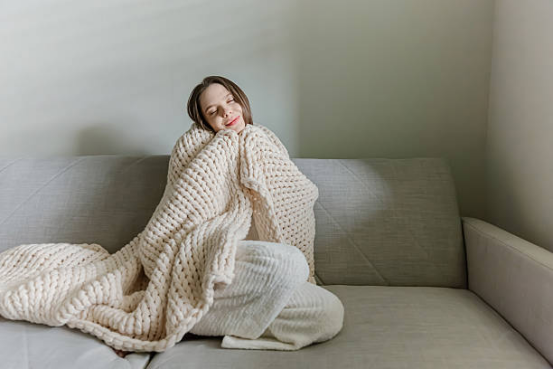
Not all blankets offer emotional relief. The feel is the first hurdle. Materials that are too rough or overly smooth will subtly increase the body’s alertness. Conversely, fabrics with a smooth surface but still retaining a certain degree of friction are more likely to help the nervous system relax.
Weight is equally important. Recent research on weighted fabrics shows that moderate pressure can help the body release tension signals, simulating the safe feeling of being “wrapped.” This experience doesn’t rely on emotional cues but is achieved through neurofeedback. For people living alone, this stable bodily feedback can effectively alleviate nighttime anxiety, improve sleep quality, and thus enhance overall solitary living happiness.
Temperature is the third often underestimated variable. It’s not about being as warm as possible, but rather about having a “predictable temperature.” When the body doesn’t need to constantly regulate its temperature, psychological resources are freed up for recovery and rest. This is why many discussions about comfort for living alone ultimately return to detailed descriptions of the Blanket’s user experience, rather than its appearance or price.
How Blanket is reshaping the experience of living alone in everyday scenarios
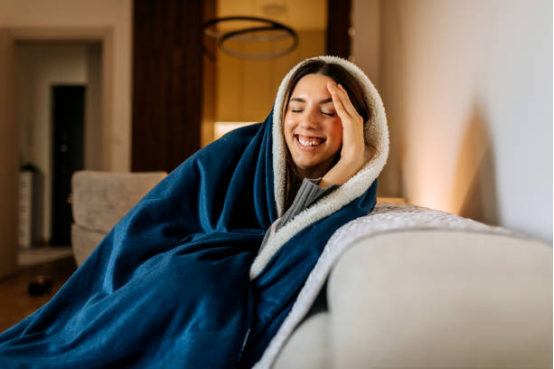
The happiness of living alone is often not perceived in momentous occasions but rather accumulated slowly in the fragments of daily life. When you wake up in the morning, is your body willing to stay still for a few more minutes? When reading on a weekend afternoon, can you maintain focus for a long time? When you are alone at night, do you feel that the space is “friendly”?
In these scenarios, the blanket plays a subtle yet persistent role. It might be draped over your lap, resting on the sofa armrest, or quietly laid out at the foot of the bed. This readily available presence itself constitutes a psychological buffer. User interviews often reveal similar descriptions: at the end of the day, returning to a space where they are alone, the first thing they look for is not their phone, but that familiar blanket.
This dependence is not weakness but a self-regulating mechanism. Especially in the absence of family members or partners, stable tactile stimulation can help people quickly switch from an “external role” to a “private state.”
Emotional dependence is not a burden but a form of self-care.
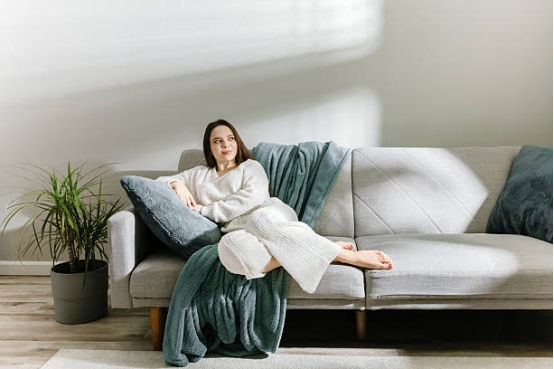
Many people are wary of the term “emotional dependence,” fearing it implies escapism or vulnerability. However, in the context of living alone, moderate emotional dependence is closer to a mature way of self-care. It doesn’t point to any particular person but rather projects onto stable and controllable elements of life.
Blankets possess these qualities: they neither respond to you nor reject you; they don’t alter your emotions, but they can stabilize them. This one-way, secure attachment is especially important for long-term solitary individuals. Research shows that when individuals can find reliable “emotional anchors” in their environment, their overall well-being scores significantly improve.
From this perspective, Blanket’s value transcends the realm of household goods. It’s more like an essential part of living alone, silently supporting the functioning of one’s emotional system.
Returning to the space itself, rediscovering the happiness of living alone.
Living alone doesn’t need to be “corrected”; it needs to be understood and optimized. Happiness doesn’t come from filling up time or forcing social interaction but from the harmony between the body and the space. When the space responds to the body’s needs, loneliness naturally diminishes.
The blanket represents this subtle yet continuous response. It doesn’t create dramatic changes but rather reduces friction in life with each use. Perhaps the real question isn’t “how to escape living alone,” but rather, what details are quietly supporting you in a life lived alone?
When the night quiets down again, have you prepared yourself with enough warmth and comfort? This may be where the happiness of living alone begins to accumulate.