
It’s late at night, you toss and turn, your phone screen flickering on and off as the clock ticks from 11 p.m. to 2 a.m. The caffeine is no longer roiling your bloodstream, but anxiety, like an invisible hand, tugs at you, preventing you from relaxing. Someone suggests trying a weighted blanket. It might sound like just a “weighted blanket,” but countless users claim it helps them fall asleep faster, wake up less often, and even relieve anxiety.
So the question is, do weighted blankets really help with sleep? Is it just psychological suggestion, or is it scientifically proven?
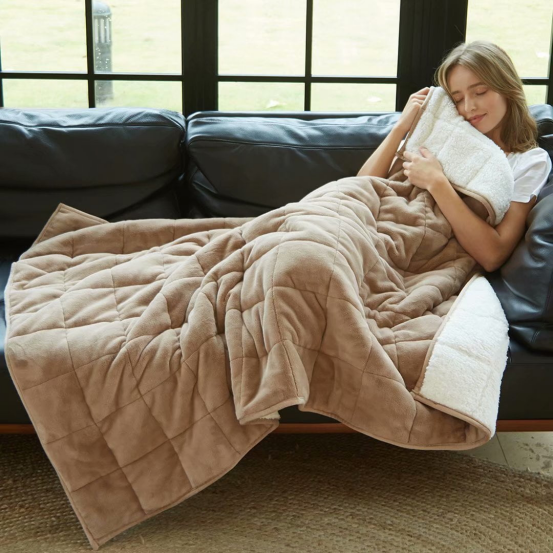
What is a weighted blanket, and how is it different from a regular blanket?
Let’s be frank: a weighted blanket isn’t a winter warmth gadget; its purpose lies in its weight.
A weighted blanket is typically filled with glass beads, steel balls, or plastic pellets and weighs about 8–12% of your body weight.
The biggest difference between this blanket and a regular blanket is the “tightly wrapped” feeling. This feeling is known in psychology as deep pressure stimulation (DPS). Simply put, when the body is subjected to evenly distributed pressure, the brain secretes more serotonin and melatonin while reducing cortisol levels. This leads to greater relaxation and easier sleep.
You can think of it as—just like the sense of security when someone gently hugged you as a child, this blanket recreates this feeling through its weight.
Scientific Evidence: Do Weighted Blankets Really Improve Sleep?
Not every trend has science backing it up, but the weighted blanket does have some research to back it up.
- In a 2015 study published in the Journal of Sleep Medicine & Disorders, 31 patients with insomnia used a weighted blanket, and approximately 63% reported that they “felt better asleep and woke up less frequently during the night.”
- A large clinical trial in Sweden in 2020 followed patients with insomnia and anxiety disorders for four weeks and showed that weighted blankets can significantly improve sleep continuity and daytime energy.
- Children: Some studies have found that weighted blankets can help relieve anxiety and sleep difficulties in children with autism spectrum disorder or sensory processing disorder.
Of course, some have pointed out that the sample size isn’t large enough and that long-term effects require further verification. In other words, the scientific community’s support for it tends to be “potential, but not yet a panacea.”
User experience: real feedback beats advertising
If you go to the sleep section of Reddit, you’ll see someone sharing their story with the weighted blanket almost every few days.
- Some people say that when they use it for the first time, “it feels like the whole body sinks, but they quickly fall into a deep sleep, and when they wake up, they don’t feel that empty feeling in the middle of the night.”
- Some people also complained that “it’s too hot and can’t be covered in summer” and finally chose the bamboo fiber blanket with better breathability.
- Another user who has suffered from insomnia for years admitted, “It’s not a miracle, but it allows me to sleep an extra hour every night, which is enough for me.”
These feedbacks make me feel that the value of a weighted blanket is not “whether it can make everyone fall asleep in seconds,” but “whether it can improve sleep quality even a little bit.”
Who is a good fit for the weighted blanket? Who might not be a good fit?
A weighted blanket is not a panacea. It is best to think carefully before choosing:
Suitable for people
- People who are often anxious, insomniac, or easily wake up in the middle of the night;
- People who like the feeling of being wrapped and are not used to thin blankets;
- Those who are looking for non-drug aids to improve sleep.
Not suitable for everyone
- Children (especially those under 2 years old) are at risk of choking;
- People with respiratory or heart diseases may feel excessive chest pressure.
- People with mobility impairments or difficulty turning over may not be able to lift the blanket by themselves.
In other words, the weighted blanket is more of an optional sleep aid than a must-have item for everyone.
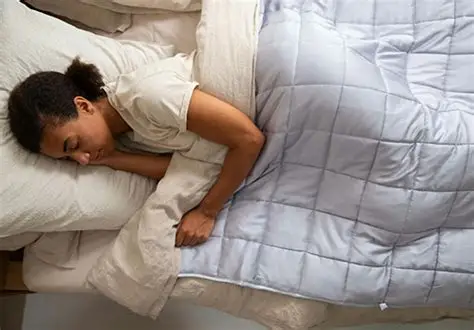
How to choose a suitable weighted blanket?
Don’t just look at “weight” when choosing; there are several key points:
- Weight selection: about 8-12% of your body weight. Too light and you won’t feel anything; too heavy and you won’t feel comfortable.
- Material: The cotton version is breathable and suitable for people who are afraid of heat; the flannel version is warmer and suitable for winter.
- Filler: Glass beads have a delicate feel and are evenly distributed; plastic particles are lighter but may be thicker.
- Removable and washable: It is best to choose a style with a detachable cover; otherwise, it will be very troublesome to clean.
Some people even buy two: a light one for summer and a heavy one for winter. This “seasonal blanket” approach is actually quite clever.
Limitations of the Weighted Blanket: It’s not magic
Having said that, I must emphasize that a weighted blanket is not the answer to all insomnia.
- It doesn’t address the underlying issues: chronic insomnia caused by caffeine, blue light from screens, or anxiety.
- The adaptation period may be long: some people fall in love with it the first time they put it on, while others need more than a week to get used to the weight.
- The price is relatively high: high-quality models may cost more than $100, which is not easy for everyone.
In other words, don’t expect to completely say goodbye to sleep problems by buying a blanket. It is more like a “boost” rather than a “panacea.”
A weighted blanket is worth a try, but don’t pin your hopes on it.
If you ask me, “Is the weighted blanket really effective for sleep?”
My answer would be: for some people, it can indeed improve sleep quality; for others, it may just be psychological comfort.
But imagine if you often toss and turn, and a little sense of security can help you sleep well; then this blanket may be a “small investment” worth trying.