
Flames don’t always appear as “accidents.” More often, they’re just an overlooked risk factor—the lingering warmth in a fireplace, an old halogen lamp by a hotel bedside, or a heater carelessly left lying around in a children’s room.
When Blanket covers these everyday scenarios, the question quietly emerges: Does it need to pass a flame-retardant test?
This question isn’t often raised directly. Most people are more concerned with the feel, thickness, and cleaning methods but rarely inquire about the blanket’s performance under extreme conditions.
However, in the global home safety and public space compliance system, flame retardancy is not an add-on option but a clear yet often misunderstood dividing line.
Why has Blanket come under the scrutiny of fire safety regulations?
From a materials science perspective, Blanket is a typical example of a “flexible flammable fabric.” It covers a large area, has a long service life, and is often in close contact with the human body and heat sources. These three factors combined make it unique in safety assessments.
In many countries’ blanket safety regulations, the requirement for flame retardancy does not depend on whether it is a “blanket,” but rather on the usage scenario. This is why products with the same appearance but bearing completely different compliance responsibilities can appear on the market.
A frequently cited industry fact is that in residential fire statistics, the initial ignition source is often not a large appliance but rather the combination of a low-power heat source and fabric. This doesn’t mean that a blanket itself is “dangerous,” but rather that its position in the risk chain is critically important.
Flame retardant requirements for home use are not a one-size-fits-all approach.
In most countries, blankets used in ordinary households are not required to meet full fire-resistant blanket standards. The reason is practical: the home environment is more controllable, users have the right to make their own judgments, and regulations are more focused on appliances and building materials.
But this does not mean that there are “no rules at all.”
In North America and Europe, for example, home textiles typically need to meet basic flammability tests, such as vertical or horizontal burning rate tests. These tests are not concerned with being “completely non-flammable,” but rather with whether the material will spread rapidly, drip, or exhibit high-risk behavior after contact with an open flame.
In actual consumption, many users mistakenly believe that flame-retardant blankets are “safer.” However, in a home setting, flame retardant treatment often comes with changes in feel, odor residue, or washing limitations. Regulatory agencies have maintained relative restraint in this regard, focusing more on information disclosure than mandatory requirements.
Therefore, the core security logic of Home Blanket is controllable risks + clear labeling + user awareness.

Why are the standards for children and infants more stringent in a blanket?
When Blanket is used for children, especially infants and toddlers, the rules will be tightened immediately.
The reasons are not complicated:
- Children lack the ability to avoid risks.
- The scenarios in which they use the products are closer to potential fire sources such as the ground, heating equipment, or nightlights.
In this area, blanket safety regulations often overlap with standards for toys and sleep products.
In European and American markets, children’s blankets are often included in the regulatory framework for child product safety. In addition to mechanical and chemical safety, flammability is one of the key evaluation items. The test focuses not only on whether it can be ignited but also on whether the combustion behavior is predictable and whether there are secondary risks.
In real-world cases, regulatory authorities have repeatedly recalled substandard children’s blankets, not because of fire incidents, but because tests revealed that they exhibited rapid spread within a short period. These recalls have directly prompted the industry to re-evaluate fire-resistant blanket standards.
In this specific area, the question of “whether flame retardancy is required” is not the point of discussion; the question of “how to comply with regulations” is.
Compliance thresholds for commercial and public space blankets
It was commercial and public spaces that truly pushed Blanket to undergo rigorous flame-retardant testing.
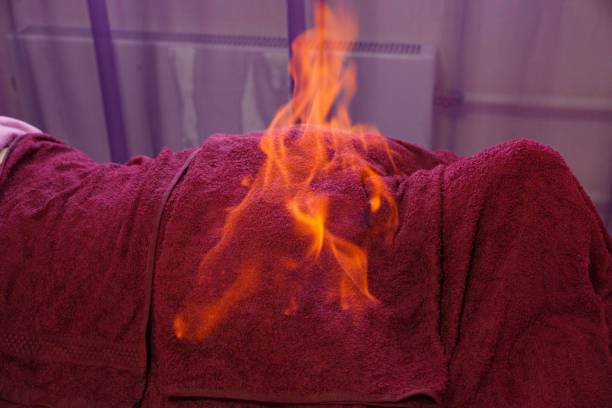
Hotels, airlines, medical institutions, cinemas, and other venues almost universally require blankets to meet explicit flame-retardant blanket standards or equivalent criteria. This is not a bias against materials but a rational judgment based on risk diffusion models.
These spaces share very consistent characteristics:
- densely populated
- Frequent user turnover
- The fire source and escape routes are complex.
In the event of a fire, any fabric that accelerates combustion will significantly amplify the consequences. Therefore, regulations typically require blankets to be self-extinguishing, have low spread, or not produce dangerous drips after exposure to an open flame.
Feedback from many hotel industry professionals confirms this: the presence of a flame-retardant blanket is not noticeable to ordinary guests, but it is an essential part of the annual fire safety inspection.
Differences in fire-resistant blanket standards across different countries
One often overlooked reality is that flame retardant standards are not globally uniform.
- North America focuses on combustion rate and dripping behavior
- Europe places greater emphasis on overall fire load and system assessment.
- In the Asia-Pacific region, local building and fire codes are often combined.
This means that the same blanket may be fully compliant in one market but may need to be retested in another. For cross-border brands or buyers, this difference is a significant component of compliance costs.
This is why the industry is increasingly emphasizing “understanding standards according to usage scenarios” rather than simply pursuing the “highest level.” Excessive flame retardancy not only increases costs but may also lead to controversies regarding environmental and health aspects.
The Other Side of Flame Retardant Treatment: User Experience and Trust Issues
From a user experience perspective, the Flame Retardant Blanket is not without controversy.
Some flame-retardant treatments can affect the softness and breathability of fabrics and may even produce a slight odor during initial use. This is why, in the home market, flame retardancy is often not an obvious selling point but rather a carefully handled piece of information.
In recent years, as consumers have become more concerned about chemical safety and transparency, some users have begun to proactively inquire whether Blanket has undergone flame retardant treatment and whether the treatment methods comply with local regulations. This change is, in turn, driving the industry to improve the quality of its information disclosure.
Flame retardancy is not mandatory, but it must be understood.
There is no single answer to whether blanks need to pass flame retardant testing. It depends on the space, the object, regulations, and the attitude towards risk.
What truly matters is not whether Blanket “sounds safer,” but whether users understand:
- in which scenarios security is guaranteed by regulations, and
- in which scenarios security requires proactive judgment.
When these boundaries are understood, flame retardant testing is no longer a vague selling point but a clear division of responsibilities.
Perhaps the next time you see a blanket label, you’ll focus not only on the material and size but also on the usage boundaries it represents. This awareness is itself part of safety.