
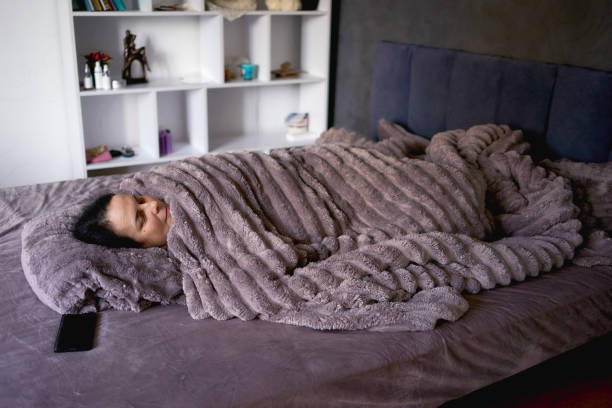
In many households, blankets are among the most easily overlooked yet frequently used items. They may not be noticed every day, but they come into contact with the skin almost daily: covered on the body, placed under the legs, draped in the corner of the sofa, or even casually wrapped around the shoulders and back while working.
Because of this “low-profile” nature, questions about whether blankets need to be replaced, how often to replace them, and whether long-term use is healthy are often simplified to a vague answer—”Just wash them clean.”
But reality is not that simple.
As the discussion shifts from “whether to clean” to “how long can it be used,” a more important but long-overlooked concept emerges:
There is a slow but continuous link between the lifespan of a blanket and health.
This is not a sudden risk but a long-term, cumulative change involving skin contact frequency, microbial environment, fiber structure aging, and the body’s adaptation to these changes.
The Real Impact of Underestimated Skin Contact Frequency
Blanket’s skin contact is quite unique among home furnishing products.
Unlike clothing, which is strictly categorized as “underwear” or “outer layer,” and unlike bed sheets, which have specific usage scenarios, its contact is irregular, repetitive, and spans multiple time periods.
During the day, it might be draped over the shoulders; at night, it covers the body; on weekends, it’s taken to the balcony or the floor; and when the seasons change, it’s taken out again for continued use.
This multi-scenario, multi-site contact makes Blanket a typical “low-intensity but high-frequency contact material.”
Some dermatological studies discussing old blanket health point out that the skin’s reaction to long-term contact with substances is often not an immediate stimulus, but rather a chronic accumulation of discomfort. Mild itching, localized dryness, and involuntary scratching during sleep are rarely directly attributed to the blanket but are more easily explained as “seasonal changes” or “fluctuations in skin condition.”
The problem is that as the same blanket is used for a long time, its surface environment has already changed, while the human body continues to adapt. This mismatch is the root cause of the overlooked risks.

Bacterial accumulation is not a hygiene problem but a matter of time.
When discussing blanket hygiene, the most common point of discussion is the frequency of cleaning. However, from a blanket hygiene lifespan perspective, cleaning only solves part of the problem.
In daily use, Blanket comes into constant contact with skin secretions, airborne dust, changes in indoor humidity, and pet hair.
Even with regular washing, a relatively stable microenvironment can still form within the fibers.
Studies show that after long-term, repeated use, the interfiber spaces in fabrics undergo structural changes, making them more prone to trapping moisture and microorganisms.
This doesn’t mean Blanket will become “dangerously dirty,” but rather that time itself is a variable. As the shelf ages, the types and distribution of microorganisms change, even if the surface still appears clean.
Some users only noticed subtle changes in sleep quality after switching to their old blanket, such as less tossing and turning at night and a decreased feeling of tightness in their skin in the morning.
These experiences are not dramatic, but they have repeatedly appeared in the feedback from multiple users, which precisely illustrates that the problem is not whether the cleaning is sufficient, but that the material itself has crossed an invisible threshold.
Fiber wear determines the blanket’s “hidden lifespan.”
Compared to bacterial issues, fiber wear and tear is less often included in health discussions, yet it may be one of the most critical factors.
Over time, blanket fibers undergo repeated stretching, friction, and washing.
Even though these changes are barely perceptible to the naked eye, they affect the fabric’s feel, breathability, and static electricity properties.
A blanket that has been used for many years is often more prone to static electricity than when it was new, has more difficulty distributing pressure evenly, and is more likely to experience friction concentration in specific areas.
From a textile health perspective, aging fibers don’t “fail” but rather gradually deviate from their original design for the human body. This is why the question of “why and how often to replace a blanket” cannot be answered with a single, uniform timeframe.
Some families in colder regions use blankets far more frequently than those in warmer regions; some people only use them while sleeping, while others wear them all day.
The different usage methods result in completely different fiber aging rates.
What truly matters is not “how many years it has been used,” but “whether it is still functioning as intended.”
Establish a focus on “lifespan” rather than “replacement anxiety.”
The problem with many health tips is that they create unnecessary anxiety. Blanket is no exception.
Simplifying the discussion to “how often to change” obscures the more valuable logical reasoning behind the advice.
A more mature approach is to establish a state-based lifetime concept:
- Does it feel noticeably harder or thinner to the touch?
- Does it absorb odors or moisture more easily?
- Did you experience any mild discomfort on your skin after use that you didn’t have before?
- Does the degree of recovery decrease significantly after cleaning?
These signals do not mean that Blanket is “unhygienic,” but rather that it is exiting the stage most suitable for prolonged skin contact.
Some experts in home maintenance point out that the health risks of household textiles often stem not from sudden contamination but from continuous use while ignoring changes in their condition. This is why simple washing recommendations are far from sufficient when discussing the health of old blankets.
An often overlooked opposing viewpoint
Of course, some people may question, “A blanket is not an intimate garment, so is it an overreaction to make health issues sound so complicated?”
This is a valid counterargument. Indeed, most blankets do not directly cause skin diseases or obvious health risks.
The issue is not about the “danger” but about the “perceived long-term effects.”
When discomfort is gradual and low-intensity, people often choose to ignore it rather than attribute it to a cause.
Because Blanket’s use is so commonplace, it’s more likely to become part of this “slow variable.”
Acknowledging this doesn’t equate to creating panic but rather to empowering users with clearer judgment.
What you really need to judge is…
Whether using the same blanket long-term is healthy is not a black-and-white question. It depends on the time, how it is used, the condition of the materials, and the body’s ability to adapt to changes.
Perhaps what’s more worth considering is this: when a blanket gradually changes from “providing comfort” to “just a habit,” are you still paying attention to its changes?
After all, health never begins only when you’re reminded but rather slowly emerges in those overlooked daily details.