
Prolonged sitting is not always an overt health problem.
It is rarely reminded of as frequently as a lack of vigorous exercise, yet it continues to occur in an extremely common and almost imperceptible way at desks, in driver’s seats, in airport waiting halls, and on hospital corridor benches.
The body does not immediately send out alarms but rather gradually accumulates fatigue through subtle signals such as stiff neck and shoulders, cold lower limbs, and difficulty concentrating.
It is precisely in these non-sleep scenarios that the blanket’s role begins to emerge.
Not designed to address pain or replace ergonomic devices, it forms a long-underestimated “buffer layer” in terms of coverage, isolation, and psychological stability.
Understanding this role requires shifting the focus from warmth to stress management and from a single function to the overall experience.
Where does physical tension accumulate during meditation?
In situations such as working, long-distance driving, or waiting at an airport, the human body often maintains the same posture beyond safe limits.
The medical and human factors engineering fields generally agree that after sitting continuously for more than 30–45 minutes, muscle tone and blood circulation efficiency begin to decline.
The problem is that most real-world scenarios do not allow for frequent getting up and moving around.
At this time, the tension in the body is not evenly distributed but concentrated in several areas:
- the lower back
- shoulders
- neck
- legs
The lower limbs, in particular, are more susceptible to the combined effects of temperature changes and slowed blood flow when sitting still. It is no coincidence that many users subconsciously drape a coat or a readily available blanket over their legs in the office environment.
From the perspective of a sitting comfort blanket, the purpose of covering the body is not simply to increase warmth but to reduce the continuous stimulation of the body by environmental changes.
When the legs are covered, the skin’s perception of airflow and temperature differences decreases significantly, the nervous system becomes less alert, and muscle tension also eases.
Although these changes are subtle, they accumulate over time during prolonged sitting.
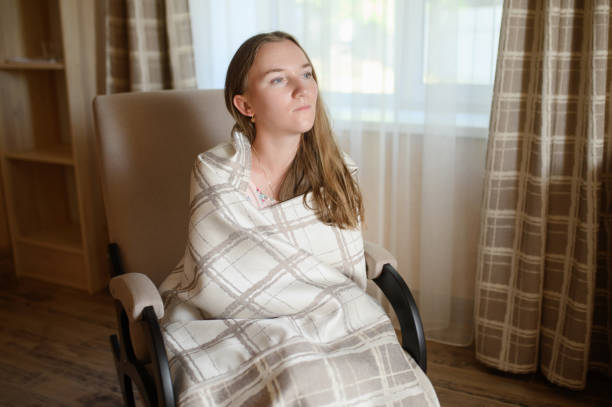
The “Envelopment Effect” in Office and Medical Care Scenarios
In offices, air conditioning temperatures are often not set for individual needs. Some people feel stuffy, while others feel cold.
The emergence of office lap blankets perfectly fills this structural mismatch.
Compared to wearing more clothing, using a blanket is more flexible and better meets the non-intrusive requirements of the office environment.
In psychology, there’s a concept called “boundary awareness,” which refers to an individual’s perception of their own space.
This sense of boundary becomes clearer when the lower body is covered by soft fabric.
Multiple studies related to stress management have indicated that light swaddling can reduce the psychological strain caused by environmental uncertainty.
This is why people tend to use blankets in high-stress, low-activity scenarios such as medical care.
The unique aspect of the caregiving scenario lies in the uncertainty of time.
Waiting often consumes more energy than taking action.
Blanket’s role here is not to provide comfort and enjoyment but to maintain a state where one can “wait for a long time,” preventing the body from prematurely reaching its fatigue threshold due to cold or tension.
Energy management during long-distance driving and waiting at airports
During long-distance driving, drivers need to maintain continuous attention, while passengers are in a passive, seated state.
While their needs for a blanket may seem different, they actually point to the same core: reducing unnecessary physical exertion.
During driving, the legs and lower back experience continuous pressure, while the airflow from the car’s air conditioning tends to concentrate on the lower limbs.
Using a blanket to cover the legs can reduce discomfort caused by temperature fluctuations without affecting operation.
For passengers, a travel waiting blanket is more like a “temporary protective layer,” helping to maintain a stable state of body movement while waiting or moving.
Airport waiting halls are another typical scenario. The environment here is designed as a functional space, not a comfortable one.
The following factors are all unfavorable for prolonged relaxation:
- The firmness of the seats
- The intensity of the air conditioning
- The noise level
Many travelers gradually feel tired while waiting, yet cannot pinpoint the reason.
The role of a blanket in this scenario is not to improve the seating but rather to reduce the body’s response to external stimuli by providing occlusion, making energy consumption more manageable.

The value of a blanket lies not in how warm it is, but in how stable it is.
A common misconception is that blankets are only for keeping warm.
However, in prolonged, sedentary settings, stability is more important than temperature itself.
Stability means that environmental changes have a reduced impact on the body, and muscles don’t need to constantly fine-tune to adapt to external conditions.
From an ergonomic perspective, any measure that reduces the need for micro-movements helps delay the onset of fatigue.
When a blanket covers the legs or lower back, the stimulation received by the skin receptors decreases, and the nervous system consequently reduces its adjustment frequency.
This mechanism explains why people still choose to use a blanket even in non-cold environments.
Some long-term office users mentioned in their experience sharing that using Blanket delayed the onset of afternoon lapses in concentration.
Although this feedback is not rigorous experimental data, it shows a high degree of consistency across multiple usage scenarios and is therefore of reference value.

Meditation is unavoidable, but energy expenditure can be managed.
In modern life, prolonged sitting is almost unavoidable.
The real difference lies not in whether one sits still or not, but in whether the body is forced to endure extra strain during sitting.
Blanket‘s role in non-sleep scenarios such as working, traveling, and accompanying caregivers is precisely to help the body reduce these unnecessary expenditures.
The next time you feel tired in an airport lounge, at your desk, or on a long drive, it might be worth reflecting on this question: Is it the task itself that’s tiring you, or the accumulation of small, overlooked anxieties?
Understanding this is often more important than finding more complex solutions.