
haven butFor many couples, the night is not always a peaceful haven, but a silent battle.
The scenario typically goes like this: around midnight, you’re trying to stick your feet out of the covers to cool off because you’re feeling hot, while your partner lying next to you is wrapped up tightly in their blanket because they’re cold, even complaining in their sleep that you’ve taken away their heat source.
This kind of partner sleep habit conflict not only affects sleep quality but can even lead to “sleep divorce”—that is, sleeping in separate rooms.
This isn’t because you’re having relationship problems; it’s purely due to biological differences.
Research shows that women generally have higher core body temperature variations and are more sensitive to cold than men, meaning that at the same room temperature, the two of you might have drastically different definitions of “comfort.”
As an industry observer who has focused on the sleep microenvironment for many years, I believe the key to solving this problem lies not in fighting for control of the thermostat, but in upgrading your bedding.
Today, we’ll discuss how to achieve harmonious coexistence of “dual temperature zones” on the same bed through scientific selection and matching of blankets.
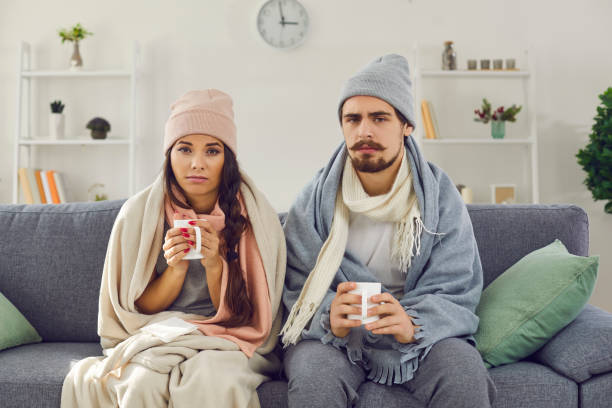
Say Goodbye to the “One-Size-Fits-All” Approach: Why Do Ordinary Blankets Always Disappoint One Person?
The problem with traditional double blankets lies in their homogeneity.
Whether it’s down, wool, or synthetic fibers, the GSM (weight in grams) and TOG (thermal resistance rating) of the entire blanket are completely consistent.
knob butThis is like a car with only one temperature control knob, but a driver who wants the air conditioning on and a passenger who wants the heating on.
- hotFor those who are prone to heat sleep: A heavy blanket hinders heat dissipation, leading to increased humidity in the microclimate, which can cause night sweats and restlessness.
- cold sleepers):For those who are sensitive to cold (Cold Sleepers): Thin blankets cannot retain body temperature, resulting in cold extremities and an inability to enter deep sleep.
couples’To solve this physical challenge, we need to introduce a new sleep philosophy: Couples temperature difference sleep solutions.
compromise butThis is no longer about compromise, but about customization.

Hardware Revolution: The Rise of Dual-Zone Blankets
dual-zoneIf you’re looking for a “one-stop” commercial solution, Dual-zone blankets are the latest market favorite.
These blankets are inspired by high-performance outdoor gear.
The core principle is to fill the left and right sides of a blanket with materials of different weights or textures.
1. Physical partitioning structure
sides.”The most common design is “different weights on the left and right sides”.
- Left side: Filled with lightweight fibers of 150-200 GSM, with excellent breathability, suitable for the side that is sensitive to heat.
- Right side: Filled with 400-500 GSM high-insulation fiber, providing a thick, enveloping feel, suitable for those who are sensitive to the cold.
This design appears as a complete blanket from the outside, maintaining the neatness and intimacy of the bed, but internally it creates two separate thermal environments.
2. Material Partitioning Magic
thickness butMore advanced dual-zone blankets not only change the thickness, but also the composition.
- Cooling zone: Use cooling fabrics containing mica particles or moisture-wicking bamboo fiber to quickly remove heat from the body surface through heat conduction.
- Temperature sensing zone: Flannel or Sherpa is used, which uses its fluffy, wavy structure to trap still air and form an insulating layer.

DIY Strategy: The Art of Layering Breathable, Warm, and Balanced Materials
If you’re not ready to buy professional dual-temperature zone products, or if you prefer more flexible combinations, then mastering the layering method of Breathable Warm Balance Materials can achieve the same goal.
I call it the “sandwich temperature control method,” the core of which lies in using the complementary properties of different materials.
First layer: A breathable base layer suitable for the entire bed.
Whether you’re sensitive to cold or heat, everyone needs to breathe.
- Recommendation: Choose a large-sized, thin blanket made of 100% Tencel or linen as your base layer.
- Principle: Tencel has excellent moisture management capabilities. For those who are sensitive to heat, it keeps them dry; for those who are sensitive to cold, it is a gentle, skin-friendly layer.
The second layer: a “thermal patch” added to one side.
This is the key to solving temperature differences.
Instead of adding a thick blanket to someone who is sensitive to cold (which would suffocate someone who is sensitive to heat), use a single-size wool throw blanket.
- Instructions: Fold the wool blanket horizontally or vertically, covering only the side of your partner who is sensitive to the cold.
- Why wool? Wool is a natural thermostat. It is both warm and breathable, so even if it is accidentally used to cover a heat-sensitive area, it will not create a stuffy feeling like polyester fibers.
Purchase Guide: For the sake of harmony, please pay attention to these details
When selecting a blanket for couples’ temperature difference sleep solutions, in addition to materials and partitions, there are two parameters that are easily overlooked:
“overflow.”1. Size must “overflow”.
One of the main reasons couples fight over the blanket is that the blanket is too small.
When one person rolls over and takes the blanket away, the other person is exposed to cold air.
- Experts recommend always buying one size larger. If your bed is queen-size, buy a king-size blanket. The extra 30-40 centimeters of headroom acts as a “safety buffer zone” for you to toss and turn at night, effectively reducing physical conflicts caused by fighting over the blanket.
2. Silent Fabric
Blankets made of knitted fabric or washed cotton are generally quieter and will minimize disturbance to your partner.
in conclusion,
Sleeping together as a couple should not be a zero-sum game—one person’s comfort built on the other’s suffering.
By choosing dual-zone blankets or cleverly layering different types of blankets, you can create two parallel microclimates on the same bed.
Remember, a good blanket isn’t just for warmth; it’s a lubricant for family relationships.
When you stop arguing about being “too cold” or “too hot,” you’ll have more cozy moments to snuggle up and sleep.
In this age of rapid technological and fabric advancements, don’t let outdated bedding hinder your intimacy.
FAQ (Frequently Asked Questions)
Q1: Is the “Scandinavian sleep method” (each person has their own blanket) better than a dual-temperature zone blanket?
It depends on your needs for intimacy.
The Scandinavian Method can indeed completely resolve partner sleep habit conflicts because each person is completely independent. However, the downside is that it creates a physical barrier in bed, reducing opportunities for skin-to-skin contact.
Dual-zone blankets have the advantage of preserving the intimacy of “sharing a blanket” while addressing temperature differences. If you value closeness, dual-zone blankets are a better compromise.
Q2: Is it troublesome to wash a dual-temperature zone blanket?
It is indeed a bit more complex than a regular blanket.
Because the density of the filling on both sides is different, the weight distribution after absorbing water is uneven. If a top-loading washing machine is used, it may cause the blanket to be off-center during the spin cycle.
It is recommended to use a front-loading washing machine and select the gentle mode. If the materials on both sides are significantly different (such as one side being wool and the other being synthetic fibers), you must strictly follow the washing instructions for the most delicate side (usually cold water washing or dry cleaning).
Q3: Besides blankets, what else can help regulate the temperature difference between couples’ sleep?
Besides upgrading the blanket, mattress selection is also crucial.
Memory foam mattresses tend to trap heat, which can be uncomfortable for the person who is more sensitive to heat. Consider placing a gel cooling mat or breathable pad on top of the mattress for the person who is more sensitive to heat.
Additionally, keeping the bedroom temperature slightly lower (around 18-20°C) and then having the person who is more sensitive to cold keep warm by adding layers of blankets with breathable warm-balance materials is generally easier to manage than raising the room temperature and making the person more sensitive to heat uncomfortable.