
In most lifestyle insight reports, “home” is often defined as a functional space: rest, work, socialize, and entertain. But true intimate relationships often “don’t follow the script”; they happen in those seemingly ordinary moments that can instantly soften the atmosphere.
Especially when a blanket appears in the center of the scene, the rhythm of the two people magically becomes synchronized. It’s as if the cotton fibers are the invisible operational role, pulling temperature, distance, and emotions into a shared frequency, soft yet efficient.
Temperature coordination during sleep: a tiny game within a blanket
Every couple faces a classic management challenge when sleeping together for the first time: the difference in perceived temperature.
One person is shivering from the cold, while the other is so hot they want to rush out to cool off.
What Blanket has to handle at night is this delicate coordination meeting.
As the overhead lights dim and the city noise gradually subsides, Blanket silently takes over the space.
It covers the shoulders, waist, and ankles of two people, integrating body temperature into a shared area, smoothing out the details in the relationship that are prone to “excessive friction.”
In this scenario, shared blanket comfort is a silent alignment:
- Who will be the first to hug Blanket?
- Who would secretly push their half towards the other?
- Who would wake up in the middle of the night to find their blanket stolen and still choose to quietly try to get it back instead of starting a fight for it?
These details are the “micro-experience indicators” in a relationship.
A blanket softens the actions of the night, transforming the rhythm of the two people from individual operation to collaborative operation.
When scattered breaths and relaxed muscles gradually converge in the same rhythmic range, that unspoken trust is usually generated under Blanket.

The morning soft start routine: from lingering in bed and stretching to the first greeting.
The start of the day often determines the emotional quality of two people throughout the day. In most real-world scenario surveys, the morning blanket plays the role of an “emotional buffer.”
The soft embrace of the blanket allowed the two people to maintain a natural fit even when they were not fully awake. In those few short minutes, there was no pressure from KPIs, no external distractions, only gradually synchronized breathing, relaxed bodies, and a natural warmth spreading.
Some couples will enter a particularly sweet operational process at this stage:
- Someone might reach under the blanket and touch the back of the other person’s hand;
- Some people will quietly rest their head on the other person’s shoulder;
- Some people would peek out from the blanket, only their eyes showing, and say sleepily, “Just five more minutes.”
These actions require no strategy; they only need the residual warmth maintained by Blanket to sustain them.
In brand and psychological behavior research, this type of “unplanned morning interaction” contributes significantly to relationship satisfaction. The blanket’s temperature at this time acts like a soft-start system, switching the rhythm of the day from “tense” to “smooth.”
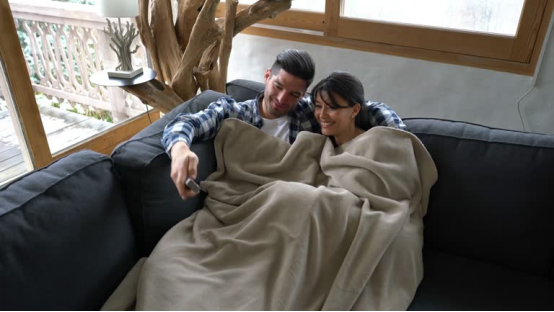
Watching movies at home: A test of compatibility in relationships
When two people snuggle on the sofa to watch a movie, the cozy fabric covering them quietly becomes the main character of the scene.
The image of two people with their legs tucked together, shoulders naturally close, and occasionally bickering over popcorn forms one of the most precious emotional assets in a relationship.
At this moment, that warm throw is no longer just a prop; it becomes the emotional foundation of the entire movie-watching ritual.
In a room with just the right temperature, the soft light from the screen falls gently over them, creating a relaxed and intimate atmosphere.
No matter whether the movie is romantic, a thriller, or something completely absurd, as long as the cover is soft and spacious enough, both hearts settle into the same shared warmth.
The truly memorable moments always happen in those few minutes when the movie is paused:
Someone suddenly asks, “Are you cold?” and then instinctively pulls the cover closer to the other person.
After a dramatic scene, one person absentmindedly taps their fingers on the fabric between them, as if expressing something without needing words.
Who spills salt on it first, who apologizes first, and who starts laughing—these become tiny, delightful Easter eggs in a relationship.
The contribution of this simple textile is undeniable; its value lies in enabling two people to draw closer effortlessly, in the most relaxed and natural way.
Weekend at home: Aligning the rhythm of two people through Blanket
Saturday afternoons are often the least celebrated, yet most genuine, time in a relationship.
Work pressures temporarily recede, external agendas clear up, and the two can finally focus their attention back on each other.
In this scenario, a blanket acts as a boundary for the couple’s private life.
Used to wrap legs, cover shoulders, cushion backrests, or even drape by the window to soften the sunlight, it transforms the rhythm of the home from “functional movement” to “emotional setting.”
Many couples like to hold their weekend rituals under a blanket:
- A cup of slow-brewed coffee;
- Two people leaning together, reading different books;
- Let’s discuss the little joys and troubles of the week.
- They were either simply spacing out, each lost in their own thoughts.
These actions may seem uneventful, but they provide the most irreplaceable sense of security in a relationship.
At this moment, the blanket embodies a “fundamental sense of security in relationship management.”
There’s a saying in psychology:
“When two people can quietly do meaningless things together, their relationship is truly stable.”
The warmth and enveloping feeling of the blanket are precisely the foundation of its quiet environment.

Rain, wind, and the lights in the house: Emotional connections under a blanket
On cloudy or rainy afternoons, the sounds outside the window automatically switch the space to a “soothing” mode.
Blanket truly shines in these moments, offering excellent ambiance management.
Some couples will lean against the window, spread a blanket on their laps, and listen to the rain while talking about topics they wouldn’t normally discuss:
childhood toys, which movie they want to see in the future, what strange scenes they’ve recently dreamed about, or a forgotten detail that suddenly comes to mind.
Sometimes, even just the gentle touch of a blanket can make a conversation more sincere, more direct, and closer to the heart.
Those moments when two people exchange emotions under a blanket—
not a ritual nor a deliberate plan, but a naturally occurring connection.
It shortens the distance between hearts to just the right degree, without pressure or alienation.
Blanket becomes an “invisible temperature memory” in relationships.
Each blanket is imbued with memory through relationships.
It remembers:
- After an argument, the two sat in silence, but each still pulled half of the blanket.
- An embrace after watching a movie late at night;
- During a trip, I sought lodging and moved between different environments, yet I maintained the same warmth throughout.
- On an ordinary night, the two of them didn’t say a word, but they both knew that the other was by their side.
These moments are not explicitly stated but exist subtly between the fibers, like soft memos.
When Blanket unfolds again, those emotions are reactivated along with the touch.
Intimacy between two people often begins with the warmth of a blanket.
In a romantic relationship, Blanket’s role is always understated.
It doesn’t create romance or solve problems.
Its job is simply to make those “little things” feel soft, tangible, and memorable.
When two people share warmth, space, and silence under a blanket, a “warmth culture” for intimate relationships is quietly taking shape.
What ultimately makes a relationship strong and touching is never a big gesture—
but rather these quiet yet solid, small, and almost overlooked acts of warmth.